 how-to
What Does a Wedding DJ Do at a Ceremony?
Last Updated: October 31, 2026
Quick Summary
A wedding DJ at a ceremony does far more than play background music. They set the mood as guests arrive, cue each processional entrance, keep the officiant's voice clear with microphones, and fade music at the right moments. The goal is a ceremony where every moment is handled smoothly, so guests hear every word.
- The ceremony prelude should stay at a low, steady volume so guests can settle in and talk.
- Processional timing creates a musical cue for each entrance: officiant, wedding party, flower girl and ring bearer, then the couple.
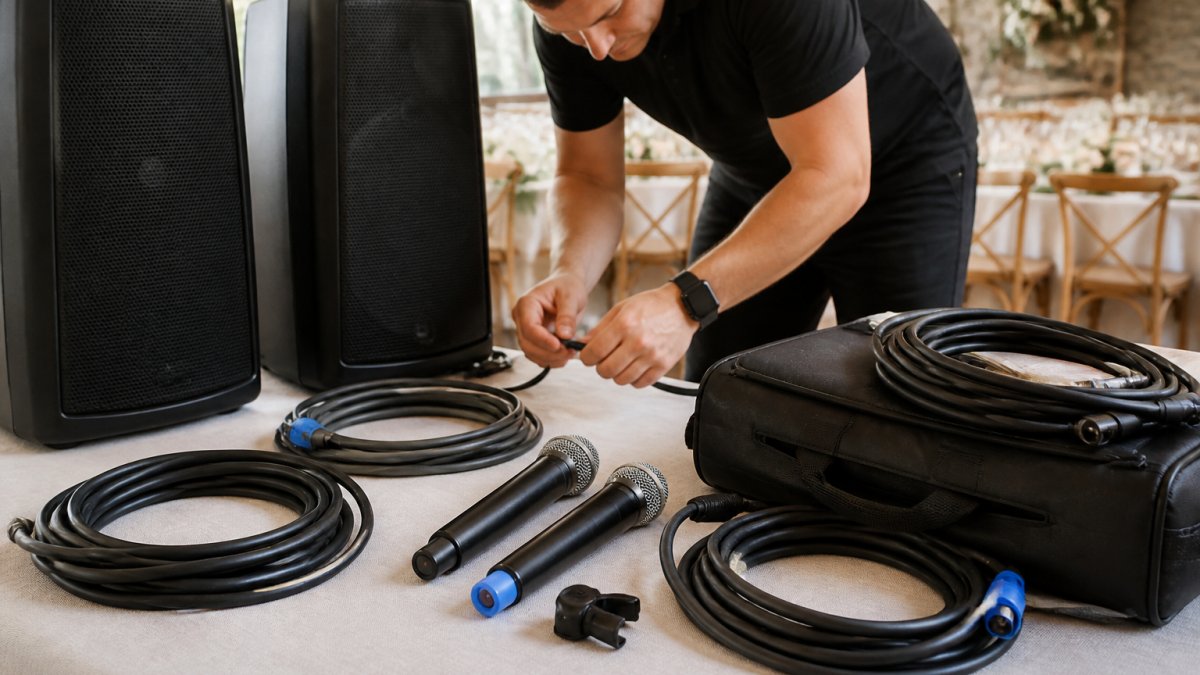
- Some ceremonies use a handheld mic, a mic stand or even a microphone for the lapel for the officiant. We provide professional equipment so guest can hear the couple and the bride and groom can have hands free during the ceremony..
- Confirm the officiant's start signal and the walk length for each entrance before the ceremony day.
- Share your song list, edited versions, and cue points with your DJ well before the wedding.
Table of Contents
- Why the Ceremony Needs a DJ Who Handles More Than Playlists
- Wedding Ceremony Music: Setting the Mood Before the Walk Begins
- Wedding Processional Songs and the Entrance Cue Sequence
- Wedding Ceremony Sound System: Microphones, Speakers, and Audio Planning
- Booking Your Ceremony Music Timeline With Your DJ
- Frequently Asked Questions
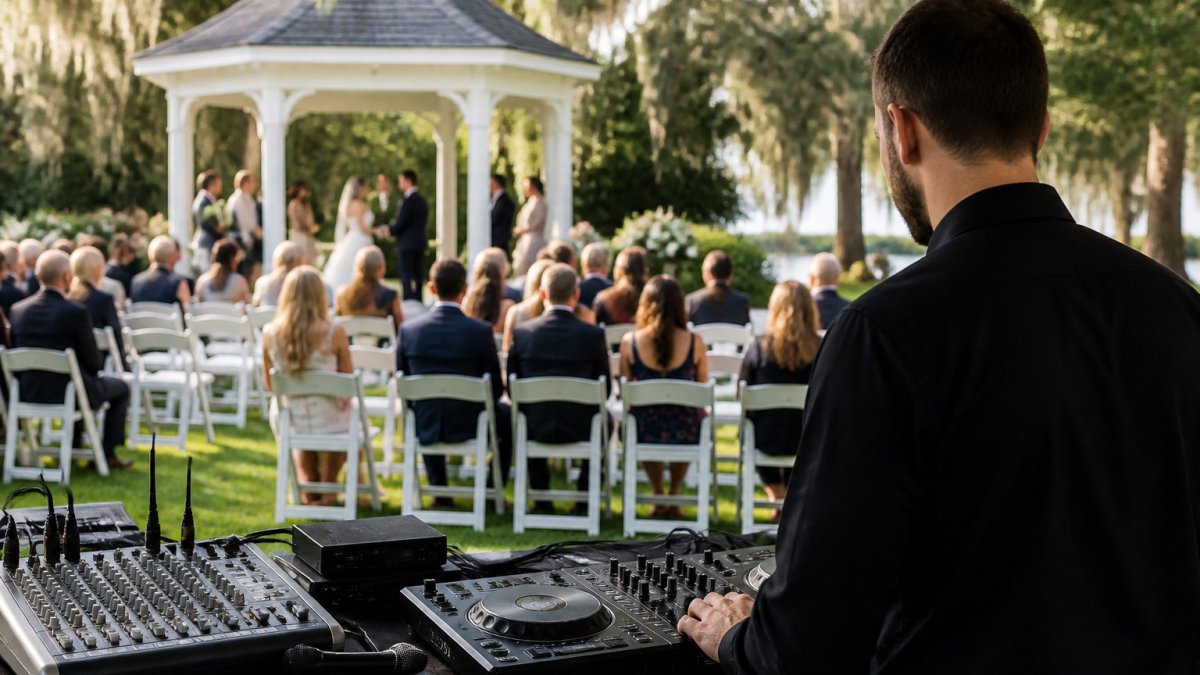
Walk into most weddings and you'll notice the music before anything else. But what does a wedding DJ do at a ceremony, exactly? Many couples assume the DJ only handles the reception dance floor. In practice, a good ceremony DJ sets the mood as guests arrive, cues every entrance, and keeps the officiant's voice clear to every seat.
Why the Ceremony Needs a DJ Who Handles More Than Playlists
A wedding ceremony moves fast and doesn't leave room for mistakes. Guests want to hear the vows, the couple wants a smooth walk down the aisle, and the officiant needs to be heard over a crowd.
A ceremony DJ manages audio, music, and timing together: starting background music before guests sit, cueing each entrance, switching to a microphone for the officiant, and fading music out at exactly the right moment.
Here's what a ceremony DJ typically covers:
- Guest arrival and seating music
- Processional cues for the wedding party
- The couple's entrance and exit
Wedding Ceremony Music: Setting the Mood Before the Walk Begins
Guest arrival music is the first thing people hear, and it shapes the whole day.
Your DJ should start arrival music at a low, steady volume, then change it clearly once the processional begins so guests know the ceremony has started.
A common mistake is choosing songs with long, sudden changes in volume or lyrics that pull attention away from the ceremony.
Wedding Processional Songs and the Entrance Cue Sequence
The processional is where timing matters most. Each entrance needs a cue, and the DJ has to hit it right every time. A typical sequence looks like this:
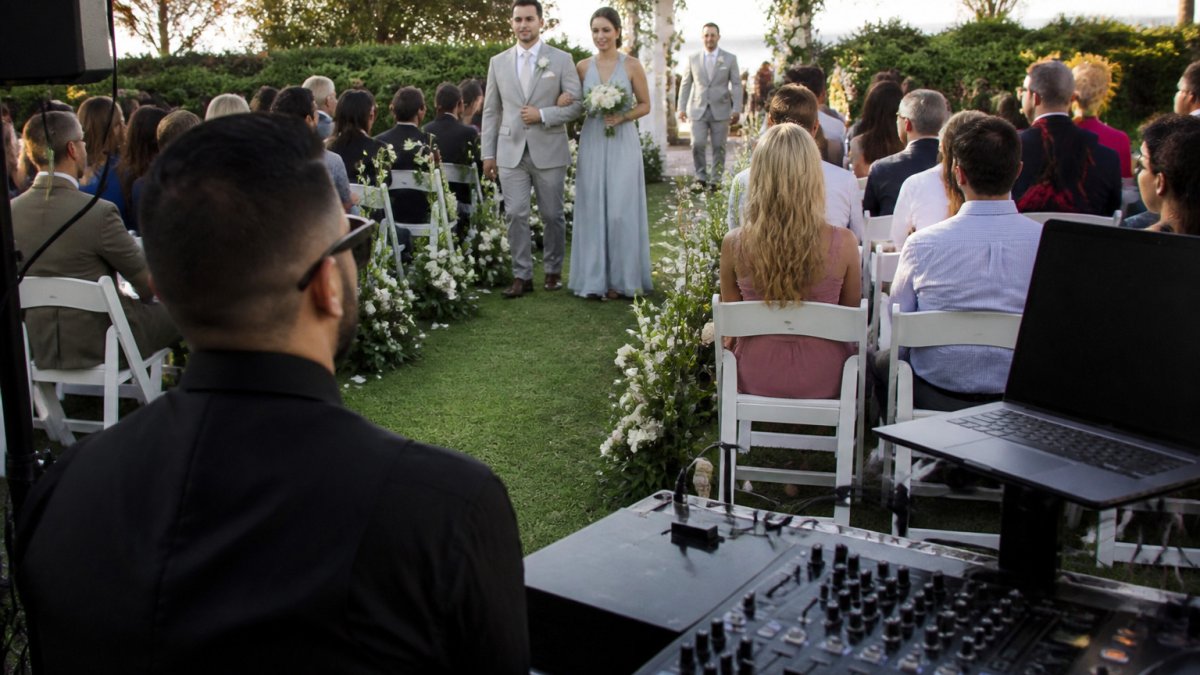
- Officiant followed by the groom
- Groomsmen enter followed by the bridesmaids
- Flower girl and ring bearer enter
- The bride's entrance, often with a special song
Before the ceremony, meet briefly with your DJ, officiant, and coordinator to confirm who walks when, how long each walk takes, and what signal the officiant uses to start. Clear communication keeps entrances smooth and avoids awkward pauses.
Wedding Ceremony Sound System: Microphones, Speakers, and Audio Planning
Good sound is the difference between a ceremony guests remember and one they strain to hear. Outdoor ceremonies, large churches, and open spaces each present different challenges, and the fix is rarely "turn it up." Acoustic considerations often shift depending on the setting, as the technical requirements for civil versus religious ceremonies dictate how microphones and speakers are positioned to ensure every vow remains clear.
Choosing the right microphone for each moment
Most ceremonies need more than one microphone, and the type matters as much as the count:
- Handheld wireless, the most flexible choice for the officiant. It projects well, works for vows and announcements, and can be passed to a reader, though someone has to hold it.
- Lapel (lavalier) clip-on, clips to the officiant's lapel or collar and keeps both hands free. Best for officiants who move or gesture, but it picks up clothing rustle.
- Headset, the most reliable for speech intelligibility because the mic stays a fixed distance from the mouth. Less common at weddings, but strong for a soft-spoken officiant in a large or windy space.
A practical setup is one lapel or headset on the officiant plus one handheld for readers and any vows the couple speaks. Confirm the plan with your officiant ahead of time so no one is surprised by a clip or a handoff on the day.
Speaker placement and speech intelligibility
The goal is even coverage to the back row without blasting the front row. A few working principles:
- Place speakers forward of the officiant and slightly to the sides so sound reaches guests rather than passing over their heads.
- Aim speakers at the seating area, not the officiant, to reduce feedback.
- Keep the officiant behind the speakers, not between them, so the mic doesn't pick up its own output.
Feedback usually comes from a mic pointed at a speaker or a gain set too high. A sound check with the officiant speaking at their real volume, not a whisper, catches most of it before guests arrive.
Check Availability & Request Pricing →
Outdoor and difficult-venue audio planning
Open-air ceremonies in Central Florida bring wind, ambient noise, and power questions. Plan for them:
- Wind, use a foam windscreen on outdoor mics and position speakers so wind hits the back, not the front, of the microphone.
- Ambient noise, traffic, fountains, or breeze through palms raise the noise floor. A headset or lapel close to the mouth cuts through better than a distant handheld.
- Power access, confirm outlet locations and any venue requirements, and bring extension and backup cabling.
Microphone handoffs and cue discipline
Decide in advance who holds the mic for vows, readings, and announcements, and rehearse the pass so it's quick and quiet.
If you're comparing ceremony coverage, check availability and request pricing and we'll walk through the audio plan for your space.
Here is a quick comparison of the microphone options a ceremony DJ typically uses, drawn from the setups described above.
Mic type | Best for | Key difference |
|---|---|---|
Handheld wireless | Officiant, vows, announcements | Projects well but must be held |
Lapel (lavalier) clip-on | Officiants who move or gesture | Keeps hands free; picks up clothing rustle |
Headset | Soft-spoken officiants, large or windy spaces | Fixed distance from mouth; most reliable intelligibility |
Second handheld | Readings, poems, unity moments | Avoids awkward handoff mid-reading |
Booking Your Ceremony Music Timeline With Your DJ
A strong ceremony timeline keeps everything on track. Share your schedule, song choices, and any special readings with your DJ well before the big day, ask for a cue-by-cue timeline that matches your ceremony flow, the document your DJ, officiant, planner, and photographer all work from.
A cue-by-cue ceremony timeline
A typical ceremony timeline a DJ builds with you looks like this:
- Guest arrival and seating, background music at a low, steady volume while guests settle.
- Pre-ceremony cue, a clear musical change signals the ceremony is starting.
- Officiant and groom's side enter, first processional cue.
- Wedding party entrances, bridesmaids and groomsmen.
- Flower girl and ring bearer, often a distinct, shorter cue.
- The bride’s entrance, the special song, cued to the moment the bride steps into view.
- Readings and unity moments, mic live for readers; music muted or faded under the moment.
- Vows and rings, officiant and couple mics clear, no music over speech.
- Recessional, the couple's exit song, followed by the wedding party.
Your DJ should confirm who walks when, how long each walk takes, and what signal the officiant uses to start. That signal, a nod, a hand raise, a word, is the difference between a smooth entrance and an awkward pause.
The music-cue worksheet to bring to your first meeting
A short worksheet saves hours of back-and-forth. Bring this to your planning meeting:
- Arrival music list (and any do-not-play songs)
- Processional order and a song for each entrance
- The couple's entrance song, with the exact cue point (intro, first verse, chorus)
Confirm edited versions and cue points early. A song with a 40-second intro can throw off a walk if no one planned for it, and a track with explicit lyrics needs a clean version agreed on in advance.
Contingency planning for the unexpected
The best timelines include a backup plan. Common scenarios and how a prepared DJ handles them:
- Late start, the DJ extends arrival music and holds the pre-ceremony cue until the officiant signals ready, so guests never sit in silence.
- Weather change, an outdoor ceremony moving under cover means re-checking speaker placement and power; a prepared DJ adapts without a scramble.
- Equipment failure, a spare microphone, cables, and batteries keep the ceremony moving while the issue is fixed.
How ceremony coverage fits your package
Ceremony coverage is often planned alongside reception coverage so one team handles both. Our six-hour and eight-hour Perfect Packages combine wedding services so you're not coordinating separate vendors for the ceremony and reception.
If you're ready to lock in ceremony music and a cue-by-cue timeline for your wedding, check availability and request pricing with our team. We'll walk you through the timeline and make sure your ceremony sounds exactly the way you imagined.
Frequently Asked Questions
What does a wedding DJ do during a wedding ceremony?
A wedding DJ at the ceremony usually handles background music while guests arrive, cues the processional and recessional, plays the couple's entrance song, and runs the microphones so the officiant, readers, and vows can be heard clearly. Many DJs also make short announcements when the ceremony begins and ends. The exact duties depend on the package you book, so confirm with your DJ which parts of the ceremony are included and who will manage each music cue on the day.
Does a wedding DJ provide microphones for the ceremony?
Many wedding DJs bring wireless microphones and a small speaker system for the ceremony, especially for outdoor locations where the officiant's voice would otherwise carry poorly. Ask whether the microphones are included in your ceremony coverage, how many are provided, and whether there is a backup microphone. A quick sound check with the officiant before guests arrive helps avoid feedback and dead spots.
When should ceremony music start?
Ceremony music usually starts 20 to 30 minutes before the ceremony, while guests are arriving and being seated. This background music sets the tone and fills the quiet time. Your DJ should confirm the start time with your planner or venue coordinator so the music begins when guests are arriving and stops when the processional begins.
Who cues the processional and recessional music?
The DJ typically cues the processional and recessional, but the timing should be coordinated in advance with the wedding planner and the officiant. Give your DJ a written order of entrances and a clear signal for when the officiant is ready. Many couples create a simple music cue sheet so every song starts at the right moment without rushing or long gaps.